Neural networks and AI
OCR with AI: text extraction
Artificial intelligence transforms OCR to achieve unprecedented accuracy and speed.
AI-powered Optical Character Recognition (OCR) in 2026 pulls text from images, PDFs and handwritten documents with over 99% accuracy. Google Cloud Vision, Amazon Textract and Tesseract OCR run on deep learning models that are not fazed by complex fonts or noisy backgrounds, where traditional OCR stumbled. At SEO7, with 8 years of experience, we implement these solutions to automate processes for companies across Spain.
- Improved Accuracy with AI
- AI models reduce errors by 80% compared to classic OCR, according to Gartner (2026).
- Complex Documents
- Extract text from invoices, contracts, and handwritten forms with tools like Amazon Textract.
- Multilingual and Multiformat
- Supports over 200 languages and formats (PDF, JPG, PNG) with Google Cloud Vision.
- Business Automation
- Integrate AI OCR into workflows to save up to 70% of time in data capture.

AI OCR in 2026 recognizes text in images and documents with deep neural networks and over 99% accuracy. Google Cloud Vision, Amazon Textract and Tesseract OCR pull data from invoices, forms and manuscripts and automate processes in banking, logistics and healthcare. At SEO7 we help Spanish companies implement these solutions.
This article tells how artificial intelligence has turned OCR on its head in 2026 and moved past the limits of traditional optical character recognition. We explain the underlying technologies (convolutional neural networks, transformers), the best tools on the market (Google Cloud Vision, Amazon Textract, Microsoft Azure AI, Tesseract OCR) and practical use cases: invoice digitization, ID card data, medical forms and more. We go over accuracy metrics (according to Gartner and Statista studies) and give a step-by-step guide to implementing AI OCR in your company. For operations directors, developers and SME owners who want to automate data capture.
How does AI OCR work in 2026?
Deep Learning and Transformers: The Engine of Modern OCR
AI OCR in 2026 rests on deep learning architectures like convolutional neural networks (CNNs) and transformers (similar to GPT). First, the model prepares the image (removes noise, adjusts contrast). Then a CNN detects text regions and extracts features. Finally, a transformer (like Microsoft's TrOCR) reads the context and recognizes characters even in handwritten or damaged fonts. According to Gartner, these systems reach 99.5% accuracy on structured documents and 95% on manuscripts. Google Cloud Vision and similar tools run on pre-trained models that adapt to multiple languages and formats.

- 1Image preprocessing: noise removal, perspective correction, and contrast adjustment.
- 2Text region detection using CNN networks (e.g., YOLO or EAST).
- 3Character or word segmentation using semantic segmentation models.
- 4Character recognition with a transformer (TrOCR) or LSTM+CTC.
- 5Post-processing: context-based spell checking with language models (BERT).
- 6Metadata extraction: identification of key fields (dates, amounts) via NER.
- 7Export to structured formats: JSON, CSV, or direct integration with databases.
- 8Optional human validation for low-confidence cases (<90%).
What are the best AI OCR tools in 2026?

Comparison of Leading Solutions
In 2026, the AI OCR tools that stand out are Google Cloud Vision, Amazon Textract, Microsoft Azure AI Document Intelligence and Tesseract OCR (open source). Google Cloud Vision reads multilingual documents accurately and integrates easily with other Google APIs. Amazon Textract works well for forms and tables, with support for invoices and receipts. Microsoft Azure AI Document Intelligence excels in medical and legal documents. Tesseract OCR is free, but reaching the accuracy of cloud solutions takes extra training. According to Statista, the AI OCR market grew 35% in 2025 and reached $15 billion.
| Tool | Accuracy (structured documents) | Approximate Price | Languages Supported |
|---|---|---|---|
| Google Cloud Vision | 99.5% | €1.50/1000 pages | 200+ |
| Amazon Textract | 99.2% | €1.20/1000 pages | 150+ |
| Microsoft Azure AI | 99.4% | €1.80/1000 pages | 180+ |
How to implement AI OCR in your company in 2026?
Practical Guide to Data Capture Automation
Implementing AI OCR in your company is best done in steps. First, identify the key documents (invoices, forms, contracts) and the fields to extract. Second, choose a tool by volume and budget: Google Cloud Vision for scale, Amazon Textract for complex forms. Third, integrate the API with scripts in Python or Node.js. Fourth, if your documentation has very specific formats, train a custom model (e.g., with Amazon SageMaker). Fifth, set up an automatic validation flow with business rules.
«Document recognition is rolled out one stream at a time, not across the whole archive. Take the most frequent document type, get it to a stable result, and only then expand.»
Summary
In summary: AI OCR in 2026
AI OCR has turned text extraction on its head in 2026: over 99% accuracy thanks to deep learning and transformers. Google Cloud Vision, Amazon Textract and Microsoft Azure AI automate data capture from invoices, forms and manuscripts, with multilingual support and affordable prices. Implementation follows key steps: preprocessing, detection, recognition and post-processing. At SEO7, with 8 years of experience, we help Spanish companies integrate these solutions and lighten their processes. The market keeps growing, and AI will keep pushing accuracy up in complex environments.
Questions and answers
What is AI OCR?
It is the technology that combines optical character recognition with artificial intelligence to extract text from images and documents with high accuracy.
What is the accuracy of AI OCR in 2026?
It exceeds 99% on structured documents and 95% on manuscripts, according to Gartner.
What are the best AI OCR tools?
Google Cloud Vision, Amazon Textract, and Microsoft Azure AI Document Intelligence are the most recommended.
Does AI OCR work with handwritten documents?
Yes, but accuracy is lower (around 95%) and depends on handwriting legibility.
How much does AI OCR cost?
Prices vary: from €1.20 per 1000 pages for Amazon Textract to free solutions like Tesseract OCR.
What languages does AI OCR support?
Tools like Google Cloud Vision support over 200 languages.
How to integrate AI OCR in my company?
Via REST APIs, scripts in Python or Node.js, and low-code platforms like Zapier.
Is it necessary to train a custom model?
Only if your documents have very specific formats; pre-trained APIs cover most cases.
Which sectors benefit from AI OCR?
Banking, logistics, healthcare, public administration, and any sector handling large volumes of documents.
Does AI OCR comply with GDPR?
Yes, as long as data is processed on EU servers and anonymized when necessary.
Can I try AI OCR for free?
Yes, Google Cloud Vision and Amazon Textract offer limited free tiers (up to 1000 pages/month).
How much time does AI OCR save?
The saving depends on the volume and type of documents, so we measure it in the pilot on your data: how long manual entry took before launch and how long it takes after.
What is the future of AI OCR?
It will integrate with multimodal models (GPT-5) to understand visual and textual context simultaneously.
How does SEO7 help companies with AI-based OCR?
SEO7 helps Spanish companies implement AI-powered OCR: text recognition in images and documents, data extraction from invoices, forms and handwriting, and process automation based on it.
Read also
 AI Systems Maintenance and Support in 2026
Discover how AI systems maintenance and support ensures optimal performance in 2026. Monitoring, updates, and incident resolution.
Read the article AI Consulting for Digital Marketing in 2026
Implement AI in your digital marketing in 2026. Automation, predictive analytics, and campaign optimization. Expert consulting in Valencia for all Spain.
Read the article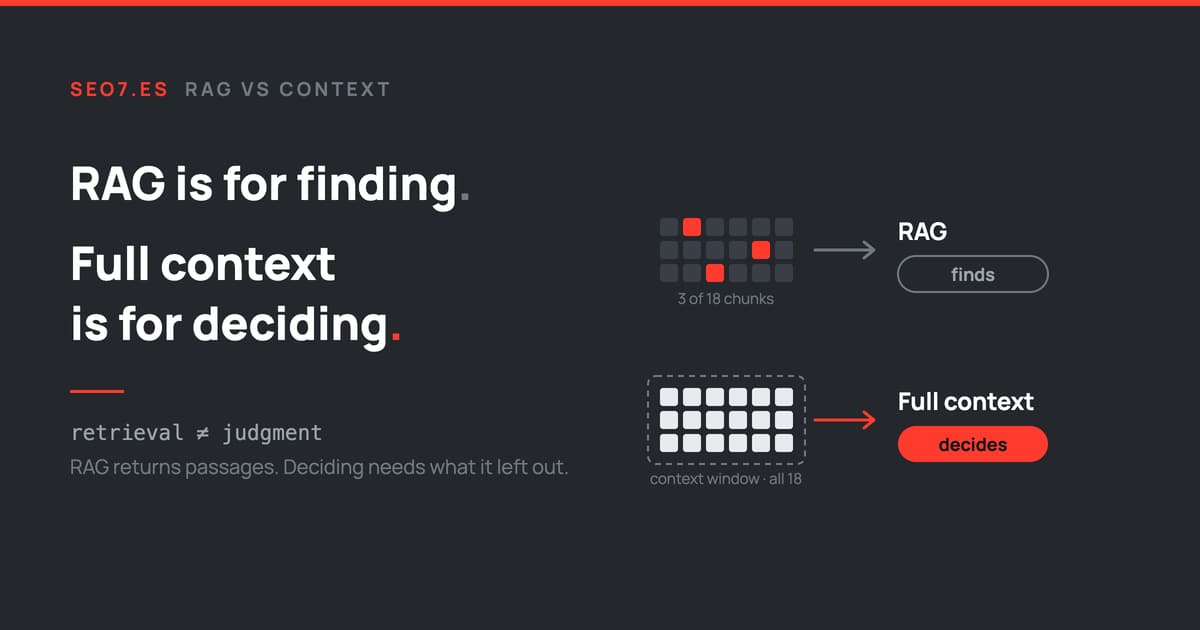 RAG is for finding. Full context is for deciding.
Retrieval finds the closest match; judgement needs the whole picture, including what's absent. Why I send the full CV instead of top-k chunks: and when I still use RAG.
Read the article